Fun & Games in the Library
While we may think about ways we access and interact with games (especially of the digital variety) as uniquely modern, playful learning and game-based learning itself is anything but new. In fact, it’s one of the most ancient ways of transmitting knowledge. We also know that play is how our youngest learners naturally engage with the world, and we see play-based learning all across the animal world. Cultivating a space where students are encouraged to adopt a curious and playful mindset is a feat all in its own; games are designed to shepherd players safely into just that mindset. Especially in a world that inundates us with stimulation to the point of despair or apathy, in my mind one of the most precious things we can offer teens is the structure, permission, and encouragement to engage in rich, challenging, and enjoyable play.
So, as a school librarian, how do we introduce more gaming and play into our programming? There’s gamification, or course, and the games that we create to lure students into engaging with library materials (scavenger hunt, anyone?). Even better, there’s considering games as a valuable form of media that we can curate and promote just as we do other sorts. Finally, we can run events and tournaments to encourage library participation, or to draw specific connections between popular games and curriculum.
If you’re looking for ideas, resources, and games, here are two excellent places to start.
Let the games begin!
Sponsored by the Games and Gaming Round Table, a part of ALA.
You can learn more about their broader goals here, which includes information on the Game On! grant and the Platinum Play Hall of Fame - a list of the best games for playing in libraries!
This celebration of games takes place every November, and it’s a great place to start. The resource guide they posted last year is particularly wonderful; it includes a plethora of print-and-play games, digital games and tools, and professional resources for library workers wanting to start game collections or clubs (that’s us!).
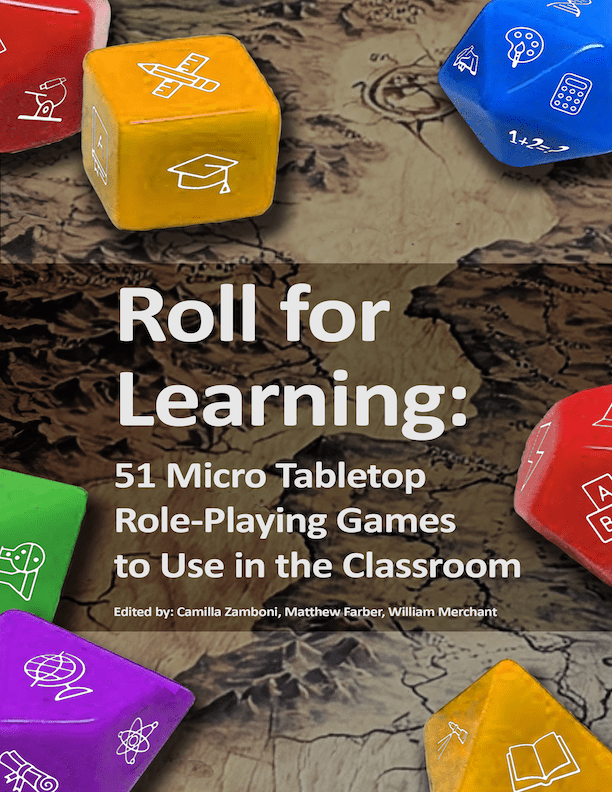
Read or download this book from Play Story Press here.
Edited by Camilla Zamboni, Matthew Farber, and William Merchant
From Play Story Press, 2024
As named, this is a compilation of 51 micro (e.g. playable in a short amount of time) TTRPGs designed specifically for use in the classroom. The book is free to download, and includes a fantastic introduction that discusses what TTRPGs are and why they can be so effective in education. It also includes a glossary of common terms used in role-playing games, with a special section just for different safety tools. These are an important part of creating a safe environment when role-playing, and are part of the social-emotional learning that can happen in these contexts. The rest of the book is divided up first by the intended age of the players, and then by topic: SEL, STEM, and Humanities. Each game includes a brief description, content areas and learning objectives, information on the game system itself (original or adapted), and an estimate as to how long a game would be. Many also include instructions for the teacher, and suggested techniques for assessment and reflection.
Personally, I am curious to try You’d Better Unionize, Baby! (p. 427) and A Request for Archival Assistance (p. 299). These games are about exactly what they sound like: how to unionize a terrible workplace (and escape a pit of alligators, of course), and how to work as a team to organize and prepare a large batch of materials for an upcoming exhibit. Some of my favorite activities!